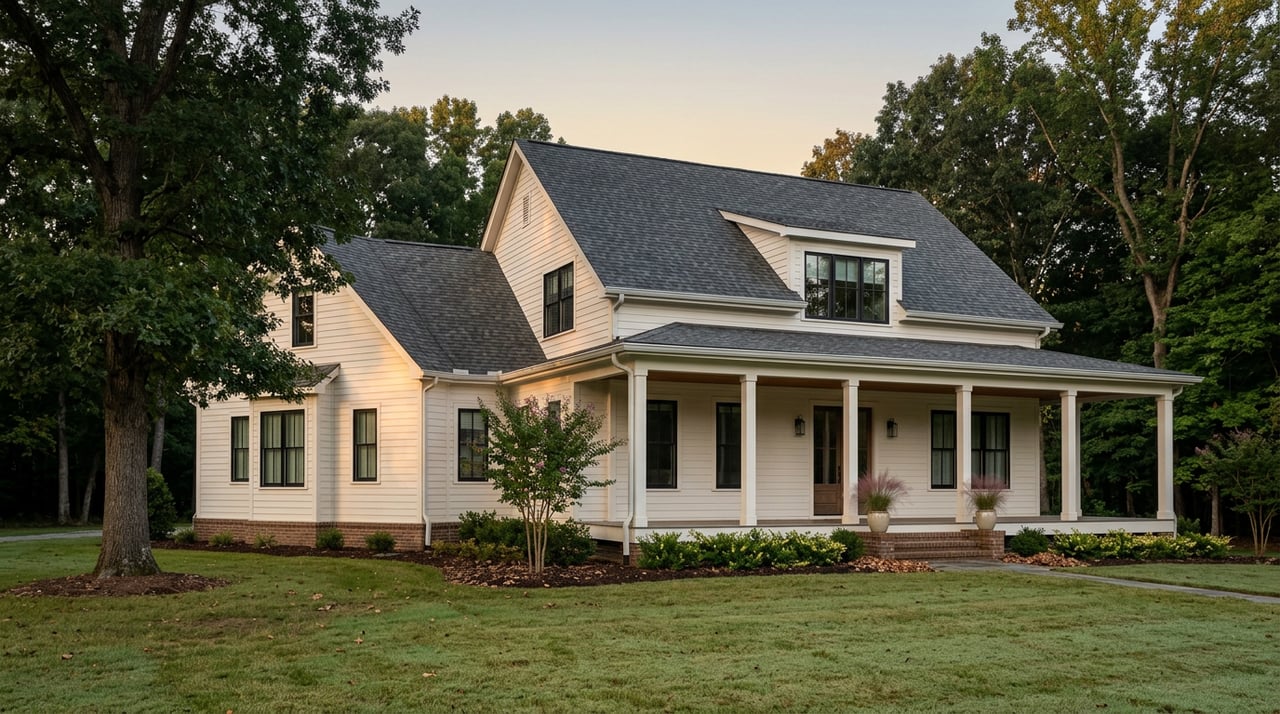
Scroll through Franklinton land listings long enough and a pattern shows up fast. Ten wooded acres for the price of a starter home. Twenty-one homestead tracts along a private road, priced well under what a comparable half-acre lot costs closer to Wake Forest. The math looks generous, especially next to anything inside the Wake County line.
Then a buyer calls to ask a simple question. Where do I send the earnest money, and which county am I actually buying in? That second question trips up more offers than the first one ever does.
Why the County Matters
Cannady Mill Farms markets itself under a Franklinton address, with GPS directions that route through Franklin County roads.
Franklin County runs its own permit portal for septic and well applications, requires a zoning permit before you can even apply for a septic permit, and keeps its own well and septic permit database going back to 2018.
Before writing an offer on any acreage tract in this area, pull the tax PIN and check it against the county GIS system rather than trusting the town name on the sign or the listing headline. A lookup can help a buyer verify parcel details before putting money down on it.
What the Per-Acre Price Is Actually Averaging
Franklin County's land market, taken as a whole, shows a median price of about $27,500 per acre in 2026, based on roughly 3,000 acres currently listed across the county. But narrow that same search to parcels specifically marketed under the Franklinton name and the average price per acre jumps to around $40,152, based on 54 active listings.
That gap is not a contradiction. It is two different baskets being compared as if they were one. The county-wide figure blends in large outlying tracts near Bunn and Louisburg, where bigger acreage and lower demand pull the median down. The Franklinton-specific figure captures smaller parcels closer to town infrastructure and to the Wake County line, where buyers are paying a premium for proximity, not just for dirt.
A buyer comparing "Franklinton land" to "Franklin County land" is really comparing two different products. Knowing which basket a given listing falls into matters more than the sticker price alone.
The Two Systems the Listing Photo Skips
Almost every raw land listing in this area carries some version of the same phrase: well needed, septic needed. That phrase is doing a lot of quiet work in the price.
North Carolina's Piedmont region, which includes Franklinton, sits on fractured granite and gneiss rather than sand or soft sedimentary rock. Water in this geology comes from cracks in the bedrock rather than from a predictable aquifer layer, which means two wells drilled 200 feet apart on the same tract can produce very different yields. That unpredictability is part of why a complete turnkey well system in the Piedmont typically runs $9,200 to $16,500 in 2026, notably higher than the $6,500 to $11,500 range typical of the Coastal Plain, where drilling moves through sand instead of rock.
Septic adds another line. A conventional system installed in North Carolina in 2026 generally runs $3,000 to $12,000, and that figure does not include the perc test and soil evaluation, which together add another $700 to $2,000. Some Franklinton listings already include this step. One Cannady Mill Farms tract advertises soils evaluated by a licensed soil scientist confirming suitability for septic, which means that cost and that uncertainty have already been cleared before a buyer ever sees the listing. Plenty of others simply say well needed and septic needed, which means the buyer inherits both the cost and the risk that a perc test comes back unfavorable.
Here is what that adds up to on a typical wooded tract before a single stick of framing goes up:
| Line item | Typical 2026 Piedmont NC cost | Already done on this parcel? |
|---|---|---|
| Perc test and soil evaluation | $700 to $2,000 | Check the listing language carefully |
| Drilled well, casing, pump | $9,200 to $16,500 | Ask if a well log exists |
| Septic system, installed | $3,000 to $12,000 | Ask for the improvement permit |
Add the low end of well and septic together and a buyer is looking at roughly $13,000 in costs that never show up in the per-acre number. Add the high end and it is closer to $30,000. On a ten-acre tract priced at $250,000, that is the difference between a $25,000-per-acre deal and one closer to $28,000 per acre once the land is actually buildable.
County Water Solves Half the Problem, Not the Whole One
Some of the larger development tracts near Timberlake Road advertise county water running along the road frontage, which sounds like it removes the well question entirely. It does, for the water side. It does not touch the wastewater side.
Rural stretches of Franklin and Granville County generally have county water lines without municipal sewer to match. Buyers who see county water on the road and assume the utility question is fully solved are only halfway there.
Running the Real Math Before You Write an Offer
A few habits turn a confusing acreage search into a straightforward one:
- Pull the tax PIN and confirm the county in the county GIS system before assuming the mailing address tells you who has jurisdiction.
- Ask the listing agent whether a perc test, soil evaluation, or existing well and septic permit already exists for the parcel, and ask to see the paperwork rather than taking the listing language at face value.
- Price the land per finished acre, not per raw acre, by adding realistic well and septic ranges to the purchase price before comparing it against another tract or against an in-town lot with utilities already run.
- If the tract sits inside a subdivision with a road maintenance agreement rather than a formal HOA, ask for the covenant document and the current annual dues.
A Short FAQ
Does every Franklinton-area lot need a private well and septic system? Not automatically. Some tracts, particularly larger parcels near roads like Timberlake, advertise county water frontage. Wastewater is a separate question.
How do I find out which county actually holds jurisdiction over a parcel? Check the tax PIN against the county GIS system and compare it to the deed registry referenced in the listing. Franklin County and Granville County both maintain public records
Is a lower price per acre always the better deal? Only when you're comparing similar parcels. A county-wide median blends in large outlying tracts that pull the number down, while parcels marketed specifically under a town name often carry a premium for proximity. Compare like to like, and add realistic well and septic costs before deciding which number actually represents the better deal.
Acreage in this part of Franklin County can be a genuinely good move for a buyer who wants space and privacy without giving up an easy commute toward Wake Forest or Raleigh. The land itself is rarely the problem. The problem is treating the price per acre as the whole story when it is usually just the opening line.
If you're weighing a Franklinton acreage tract against an in-town lot in Wake Forest or Youngsville, or you just want a second set of eyes on a listing before you write an offer, Stephanie Santiago is happy to walk through the real numbers with you. Schedule a free consultation and get the full picture before the paperwork does the talking for you.
This article is general information, not legal, tax or financial advice. Consult a qualified professional about your situation.